











The Gas Turbine Types Slide will give you more information about the various engine types. There is also a slide devoted only to turbojet engine operation.
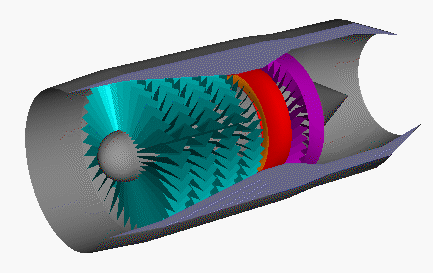
On this slide we show a computer drawing of a turbojet engine. Large amounts of surrounding air are continuously brought into the engine through the inlet. We have shown here a tube-shaped inlet like one you would see on an airliner but inlets come in many shapes and sizes depending on the aircraft's mission. At the rear of the inlet, the air enters the compressor. The compressor acts like many rows of propellers with each row producing a small jump in pressure. At the exit of the compressor, the air is at a much higher pressure than free stream. In the burner, a small amount of fuel is combined with the air and ignited. (In a typical jet engine, 100 pounds of air/sec is combined with only 2 pounds of fuel/sec. Most of the hot exhaust has come from the surrounding air.) Leaving the burner, the hot exhaust is passed through the turbine which extracts energy from the flow of gas. In a jet engine we use the energy extracted by the turbine to turn the compressor by linking the compressor and the turbine by the central shaft. The turbine takes some energy out of the hot exhaust, but there is enough energy left over to provide thrust to the jet engine by increasing the velocity through the nozzle. Because the exit velocity is greater than the free stream velocity, thrust is created as described by the thrust equation.


Last Updated Thu, May 13 02:38:16 PM EDT 2021
by Tom Benson