NASA Glenn Videoconference: Exploring Mars
Post-Conference Activity, Crater Simulation: Answers


  1. Complete the first three columns of the table below.

    Note: The formula to calculate the diameter of an object is C/3.14 = D, where C represents the circumference in mm, and D equals the diameter in mm.
    Impactor #
    Impactor Description
    Impactor Diameter (mm)
    Impactor Mass (g)
    Crater Diameter (mm)

    Crater Depth
    1
    Answers will Vary
    Answers will Vary
    Answers will Vary
    Answers will Vary
    Answers will Vary
    2


    3


    4


    5


    6


    7


    8


    9


    10


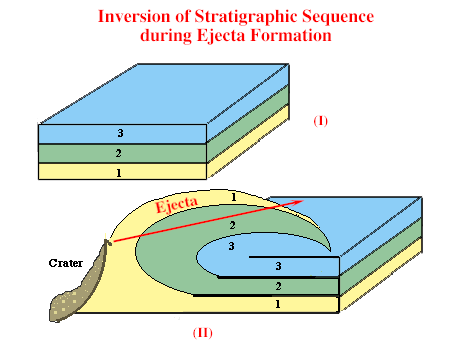
  2. a) Fill the box lid 4 - 6 cm high with the light colored powder and lightly smooth it with a ruler.
    b) Then sprinkle a 0.5 - 1 cm layer of dark powder over the light colored powder and smooth it with the ruler, being careful not to mix or pack the two layers. Your Mars surface is now ready for crater formation.

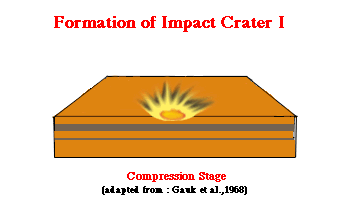
  3. a) Drop the largest impactor onto a section of the surface from a height of two meters.
    b) Remove the impactor.
    c) Measure the diameter of the crater and record it in the last column of the table above.
    d) Sketch and describe what you see.


    e) Answer the following questions below your sketch:
    1. Did the layers mix as a result of the impact? If so, how? Answers will Vary
    2. Which layers are visible in the crater? At the rim? Beyond the rim?Answers will Vary
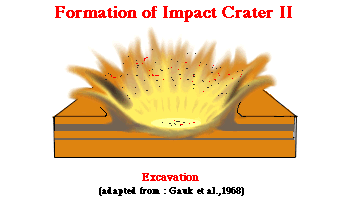
    3. Is the ejecta thrown out evenly in all directions? Answers will Vary
    4. How large is the crater compared with the impactor? Answers will Vary
    5. How do the following properties of the impactors seem to affect the crater dimensions?

      Mass affects diameter and depth of the crater.

      Size affects diameter and depth of the crater

      Velocity
      affects diameter and depth of the crater

      Shape
      affects diameter and depth of the crater
    6. Besides the diameter, is there something else about the crater's dimensions that could be recorded? Add another column to the table above and begin documenting this dimension. Make sure you label it in the column heading and add the units. Depth of the crater

  4. a) Repeat step 3 with another impactor.
    b) Observe and document your findings and examples including comparisons with the first drop.
    c) Continue until all impactors have been dropped.

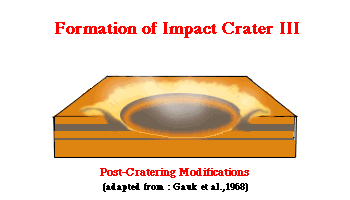
    You have just used another tool that scientists can use in their investigations--a model that simulates something. You simulated the formation of craters on Mars by dropping objects to form craters and observing what happened. Now that you have gained more knowledge, it is time to finalize your scientific explanations of how craters formed on Mars.

    Make any final observations and set the trays aside to refer to later. Revise your scientific explanations about how the craters were formed and document your findings in the space below. Go back to the photo images, your notes, and your models to make comparisons.

  5. Review the photos of Mars and Earth, your notes and pictures, and the simulated crater model and note any obvious findings.

    Terrestrial/Geological features should be compared and noted.

    Uplift, ejecta, rim, erosion, and strata features can all be mentioned.

    Also, students might mention the angle of impact and how it can affect crater formation.

  6. Finalize your scientific explanation.

    Answers will vary

  7. Document your evidence.

    Answers will vary


    Additional Questions:

  8. Did your scientific explanation change? How?

    Answers will vary

  9. What caused you to change your explanation?

    Answers will vary

  10. How could future scientists benefit from your findings?

    Answers will vary

  11. What are some other ways that scientists could investigate craters on the surface of Mars?
    Answers will vary

Videoconference Description and Introduction
Pre-conference assessment
Pre-conference activity and worksheet
Post-conference activity and worksheet
Post-conference assessment

 
Please send any comments to:
Web site related: Curator
Content related: Joe Kolecki (Joseph.C.Kolecki@grc.nasa.gov)