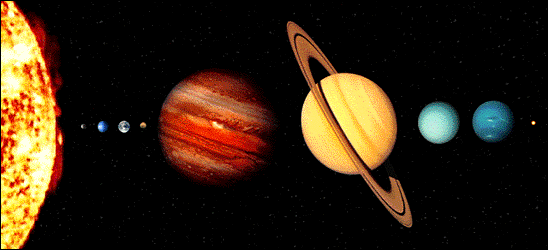
NASA Glenn Videoconference: Exploration of the Solar System/Space and the Solar System
Subject Area(s): Science
Grade Level: 5 - 8
National Standards:
NASA Glenn Videoconference: Exploration of the Solar System/Space
and the Solar System
Subject Area(s): Science
Grade Level: 5 - 8
National Standards:
ScienceEarth and Space Science - Structure of the earth system; earth's history;earth in the solar system.
Science as Inquiry - Abilities necessary to do scientific inquiry; understanding about scientific inquiry
Science and Technology - Abilities of technological design;
understanding about science and technology
Science in Personal and Social Perspectives - Personal health;
populations, resources, and environments; natural hazards;
risks and benefits; science and technology in societyTechnology
Social, Ethical, and Human Issues - Research and evaluate the accuracy, relevance, appropriateness, comprehensiveness, and bias of electronic information sources concerning real-world problems.
Problem-Solving and Decision-Making Tools - Routinely and efficiently use on-line information resources to meet needs for collaboration, research, publications, communications, and productivity; design, develop, publish and present products (e.g., Web pages, video tapes) using technology resources that demonstrate and communicate curriculum concepts to audiences inside and outside the classroom.
Research Tools - Use content-specific tools, software and simulations (e.g., environmental probes, graphing calculators, exploratory environments, Web tools) to support learning and research; research and evaluate the accuracy, relevance, appropriateness, comprehensiveness, and bias of electronic information sources concerning real-world problems.
Objective(s):
In the pre-conference activity, students will be introduced to the study of our solar system through an inquiry-based approach to learning. The students will be guided to specific resources to gather information about the solar system. Students will then participate in a NASA videoconference. As a follow-up, to reinforce the lesson, students will construct a tri-fold travel brochure on a tour to one of the planets, moons, or asteroid belts found in our solar system.
Note: This lesson may be completed with students working in groups or individually.
Submitted by: Lea Einsporn and Dana Flenner, University of Akron, Akron, Ohio.
|
|
|
|
|
|