

Velocity Effects Problem Set
Subject Area: Physics, Physical Science, Algebra I
Grade Level: 9-12
National Standards:
Mathematics
- Demonstrate the ability to read written presentations of mathematics with understanding.
- Use tables and graphs as tools to interpret expressions, equations, and inequalities.
Science
- Physical Science: Motions and forces.
- Science as Inquiry: Understanding about scientific inquiry.
- Science and Technology: Understanding about science and technology.
Technology
- Research Tools - Use content-specific tools, software and simulations (e.g., environmental probes, graphing calculators, exploratory environments, Web tools) to support learning and research.
- Problem-Solving and Decision-Making Tools - Routinely and efficiently use on-line information resources to meet needs for collaboration, research, publications, communications, and productivity.
Objective:
- After reading an explanation on lift from a NASA Web-based textbook and an explanation on the FoilSim software package given below, use FoilSim to evaluate the relationship between velocity and lift.
Beginner's Guide to Aerodynamics is a "textbook" of information prepared at NASA Glenn Research Center to help you better understand how airplanes work. Click Beginner's Guide Index to access the list of slides. Open the slide called Velocity Effects (with text) and read the explanation on how velocity affects lift.
FoilSim is an interactive simulation software package that examines the airflow around various shapes of airfoils. As you change parameters such as airspeed, altitude, angle of attack, thickness and curvature of the airfoil, and size of the wing area, the software calculates the lift. The package was created at the NASA Glenn Research Center.
FoilSim II is a Java applet program that executes inside the browser of your computer. It is available on the World Wide Web at http://www.grc.nasa.gov/WWW/K-12/airplane/foil2.html. You can also download the program to run off-line.
Shown below is a screen shot from the program's controls and displays. You may change the values of the variables by using the slider or the input box on the left of the slider.
To use the slider:
- Click the mouse pointer on the arrows at the ends of the slider.
- Click the mouse pointer anywhere between the slider and the arrow.
- Drag the slider with the mouse.
To use the input box:
Simply select the value in the input box, key in the new value, and press Enter or Tab when finished. The button on the slider will move corresponding to the value typed in the box.
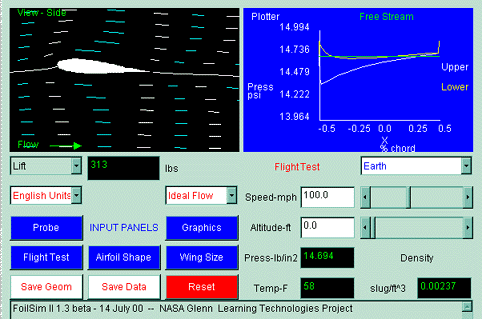
Now, using the information shown at Velocity Effects Problems, complete the problems designed to demonstrate your ability to calculate the effects of changing velocity on lift. (Calculate lift and velocity to the nearest newton or km/h.)
Assessment:
You, or you and your partner(s), will be evaluated on the accuracy or feasibility of your answers.
Evaluation:
- You will demonstrate the ability to use information found on the World Wide Web and FoilSim to evaluate the relationship between velocity and lift.
-
Submitted by: Dan Tuttle, Lorain Admiral King High School, Lorain, Ohio
EDUCATOR RESOURCES | AERONAUTIC EDUCATIONAL RESOURCES | INTERNET ACCESS RESEARCH | ICING RESEARCH TUNNEL
BEGINNER'S GUIDE TO AERONAUTICS | FREE SOFTWARE | AERODYNAMICS INFORMATION | AERODYNAMICS PROBLEMS | PROPULSION INFORMATION |
PROPULSION PROBLEMS | FOILSIM INFORMATION | FOILSIM PROBLEMS | ENGINESIM INFORMATION | ENGINESIM PROBLEMS | ROCKETMODELER
AERONAUTICS LESSONS & ACTIVITIES | WIND TUNNEL WEB PAGES | AERONAUTS 2000 | VIDEOCONFERENCES WITH THE U.K.
Curator: Tom.Benson@grc.nasa.gov
Responsible Official: Kathy.Zona@grc.nasa.gov