|
|
|
|
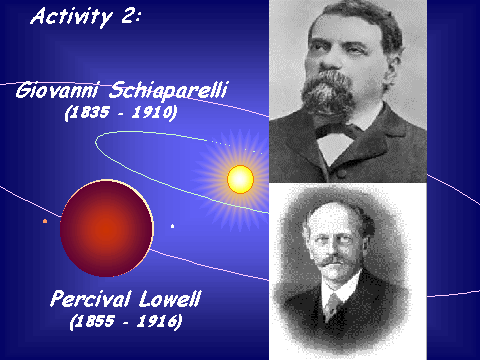


After Galileo introduced the telescope in Venice in the 17th century, its use as an astronomical instrument spread across Europe, and astronomy made remarkable advances. In the 19th century, among many varied discoveries, the planet Mars came into prominence as having two moons (A. Hall) and a surface marked by dark, linear features (G. Schiaparelli). A poor literary translation of Schiaparelli’s Italian ‘canali’ to the English ‘canals’ rather than to ‘linear features’ lead the American, P. Lowell, to conclude that Mars must be inhabited by a race of highly intelligent beings who were desperately trying to save their dying world by building a massive irrigation system to move water from the Martian poles to the mid and equatorial regions where, according to Lowell, there were great metropolitan areas succumbing to advancing Martian desserts. Lowell went on to build an observatory near Flagstaff, Arizona, to observe Mars, and to write about its inhabitants in ever greater detail for the rest of his life. Lowell’s conclusions were flawed, of course, but his florid style and vivid imagination has added much to our 20th century heritage of science fiction and lasting pubic enthusiasm about Mars.
Slide 6 of 20