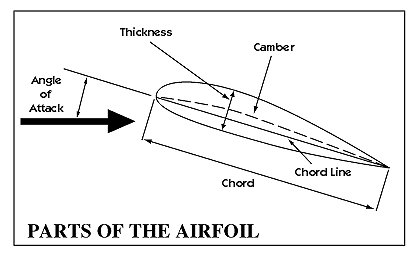
 The angle of attack is the angle created between the relative wind and the chord line. The chord line is an imaginary line drawn from the leading edge of the wing to the trailing edge. The relative wind is the air that moves directly opposite of the flight path of the airplane. If you hold your hand out of the window of a fast moving car and tilt your hand up slightly, your hand rises because the air flowing under your arm is moving slower than the air flowing over it. The slower moving air causes higher pressure which pushes your arm up. This is the same concept as increasing the angle of attack in an airplane. The angle of attack is the angle created between the relative wind and the chord line. The chord line is an imaginary line drawn from the leading edge of the wing to the trailing edge. The relative wind is the air that moves directly opposite of the flight path of the airplane. If you hold your hand out of the window of a fast moving car and tilt your hand up slightly, your hand rises because the air flowing under your arm is moving slower than the air flowing over it. The slower moving air causes higher pressure which pushes your arm up. This is the same concept as increasing the angle of attack in an airplane. |
| As the angle between the chord line and the relative wind increases, the air flowing under the wing will move slower, creating greater pressure. The slower the air flow under the wing, the greater the pressure. Conversely, the greater the air flow over the wing, the lower the pressure. As a result, the greater the angle of attack, the greater the lift created. |
| Unfortunately, there is a point, called the "critical angle of attack," where the air does not flow smoothly around the wing and begins to separate and be disrupted. The production of lift drops very rapidly, causing your plane to stall. |
| QUESTIONS - BACK |
Curator: Tom.Benson@grc.nasa.gov
Responsible Official: Kathy.Zona@grc.nasa.gov