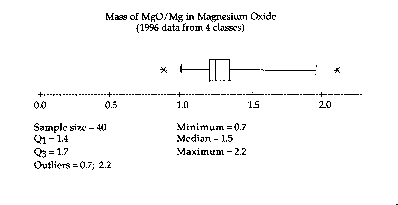
Students burned known mass samples of magnesium in crucibles. Mass of magnesium oxide was determined after the combustion. Mass ratio of magnesium oxide to magnesium was listed for each of the four classes in a graphing calculator. Data analyzed statistically by finding median, range, Q1, Q2, Q3, mean and standard deviation.
The data was also calculated for the combined classes. Box, whisker and histogram plots were sketched for the combined data.
The accepted value of the mass ratio is 1.65 and students were asked to see how close their data came within 2 standard deviations. Presence of the outliers was discussed.
e-mail FenL@aol.com for acitivity V worksheets
Source: Experiment from Heath Chemistry, Laboratory Experiments, DiSpezio, Hall, Schrader and Young, D.C. Heath and Co, 1987.
Hang times of student jumpers were measured using a laser, CBL and light sensor. Box and whisker plot and outliers were determined using the graphing calculators. This activity gave pictorial representations of data.
Source: Real World Math with the CBL System, Brueningsen, Bower, Antinone, Breningsen, Texas Instruments, 1994.

Go Back to Math-Science Connections
Go Back to Main Menu