Thermodynamics is a branch of physics that deals with the energy and work of a system. As mentioned on the gas properties slide, thermodynamics deals only with the large scale response of a system that we can observe and measure in experiments. As aerodynamicists, we are most interested in the thermodynamics of propulsion systems.
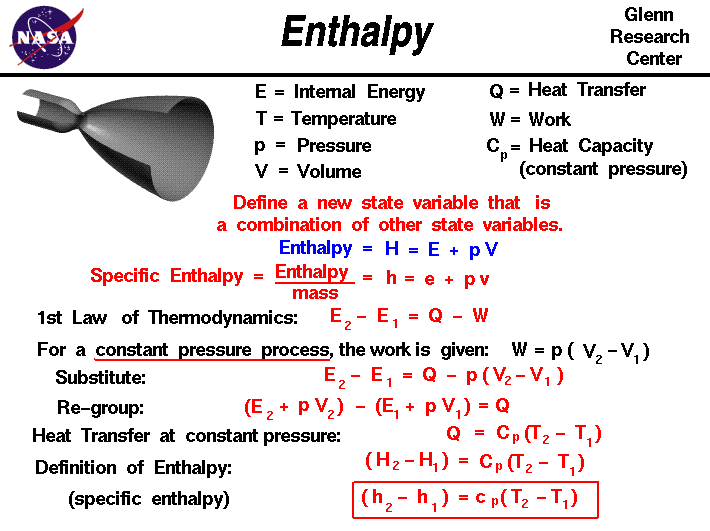
The state of a gas is defined by several properties, including the temperature, pressure, and volume that the gas occupies. From our study of the First Law of Thermodynamics, we have found that the internal energy of a gas is also a state variable, that is, a variable that depends only on the state of the gas and not on any process that produced that state. We are free to define additional state variables that are combinations of existing state variables. These new variables often make the analysis of a system much simpler. For a gas, a useful additional state variable is the enthalpy, which is defined to be the sum of the internal energy plus the product of the pressure and volume (as shown in the middle of the slide). The enthalpy can be made into an intensive or "specific" variable by dividing by the mass. Propulsion engineers use the specific enthalpy in engine analysis more than the enthalpy itself.
A sample use of the enthalpy variable is shown on this slide. If we start with the First Law of Thermodynamics for a gas, the work and heat flow, in general, depend on the process. For the special case of a constant pressure process, the work done by the gas is given as the constant pressure times the change in volume. Substituting into the first law equation, we have expressions (U + pV), which can be combined using the enthalpy (H). From our definition of the heat flow, we can relate the change in enthalpy to the heat capacity and the difference in temperature. We have enclosed the terms of the equation in parentheses with a "p" subscript to remind ourselves that this equation is true only for a constant pressure process. At the bottom of the slide, we have divided by the mass of gas to produce the specific enthalpy equation. The specific heat capacity (cp) is called the specific heat at constant pressure and is related to the universal gas constant of the equation of state. This final equation is used to determine values of specific enthalpy for a given temperature. The enthalpy is also used in the evaluation of the work done on the flow by a compressor or the work available from a power turbine.



Last Updated Thu, May 13 02:38:28 PM EDT 2021
by Ruth Petersen
7/11/2000