Design of Airfoil and Problem-Solving Using
FoilSim
Answers
Answers

|
|
Answers |
|
|
50 mph |
100 mph |
150 mph |
200 mph |
|
Lift =506.6 |
Lift =2026 |
Lift =4559 |
Lift =8106 |

As velocity doubles, lift quadruples.
Step 2. Set the angle at 2.5 and record lift. Repeat, setting the angle for 5.0, 7.5, and 10 and record lift for each setting. Graph the results. At what point will the airfoil not turn a flow? Airflow does not turn a flow at 3.5o. Complete your graph with a stall at an angle of 12. Will lift be generated at an angle of 0? No Explain.
Answers will vary.
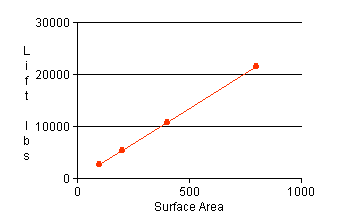
Step 3. Return the angle setting to 2.5 and set the surface area to 100 sq.ft. Record the value for lift. Double the surface area. How is lift affected? Record lift. Double surface area two additional times and record lift. Graph lift vs. surface area from the data recorded. Explain how an airplane can slow its velocity for landing and still maintain sufficient lift to avoid a stall.
|
Surface Area=100 |
Surface area=200 |
Surface area=400 |
Surface area=800 |
|
Lift =2702 |
Lift =5404 |
Lift =10810 |
Lift =21610 |
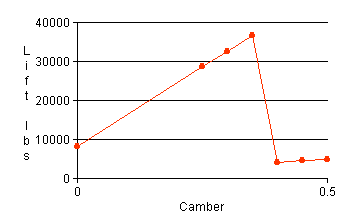
Step 4. Set the camber at 0. Record lift. Increase camber to .25, .30, .35, .40, .45, and .50 and record the changes in lift for each setting. Graph camber vs. lift with the data recorded. Is it possible for camber adjustment to initiate a stall? Explain.
|
|
|
|
|
|
|
|
|
Lift =8106 |
Lift =28590 |
Lift =32690 |
Lift=36790 |
Lift =4088 |
Lift =4498 |
Lift =4907 |
Step 5. Return the camber setting to 0. Adjust the altitude slider to 15000 ft., 25000 ft., 35000 ft., and 45000 ft. and record lift at each setting. Graph lift vs. altitude with the data collected above and predict the next two points on the graph. Is lift affected by an increase in altitude? List possible reasons for any changes observed.
|
15000 feet |
25000 feet |
35000 ft |
45000 ft |
|
Lift =5922 |
Lift =4220 |
Lift =2920 |
Lift =1814 |

Step 6. An airplane is beginning its descent at an altitude of 1500 ft. and a beginning velocity of 200 mph. Gradually decrease altitude and velocity and note the change that occurs in lift. Record your observations. Explain how the lift force can be maintained while velocity and altitude are being decreased as the airplane approaches landing. Check your explanation using the FoilSim demonstrator. Summarize your results.
Discussion must include angle of attack and camber.
Step 7. An airplane travels 40,000 feet horizontally from the point where it began its descent at an altitude of 1500 feet. Draw a diagram of the descent showing the vertical and horizontal components, and calculate the angle of descent for the airplane.
Angle of descent = 2o
Design and build a paper airplane that has the longest time aloft and travels the greatest distance.
Step 1.
Use unlined paper for your construction. Determine the wing area by
breaking areas of the wings down into triangles and rectangles.
Measure and calculate.
Answers will vary.
Step 2.
Using the same launch angle and velocity, fly your airplane through
five trials. Measure the wing surface area, distance traveled, and
angle of inclination for the wings in each trial. Make a data table
and record your results. Repeat the trial flights for time aloft.
Again, record the wing surface area, time aloft, and angle of
inclination for the wings in each trial. Graph the area/time or
area/distance data for each set of trials. The trial flights must be
completed indoors to eliminate wind effects.
Answers will vary.
Step 3.
Write a summary of your results.
Answers will vary.
Step 4.
Cut one inch off the trailing edge of the wings. Place the cut off
pieces within the folds of the airplane so the mass remains
constant.
Step 5.
Repeat the trial flights, data collection, graphing, and written
summary as above.
Answers will vary.
Design and construct airplanes with other wing shapes. Repeat the steps of the preceding activity for each design. Provide a written discussion comparing all results.
Answers will vary.
 |
 |
 |
|