|
|
|
|
|
|
Subject Area: Physics, Physical Science
Grade Level: 9-12
National Standards:
Objectives:
After reading the explanation given below, use FoilSim to complete the activity to design an airplane wing that generates a given lift.
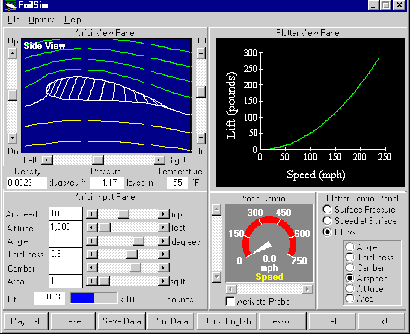
FoilSim is an interactive simulation software package that determines the airflow around various shapes of airfoils. As you change the parameters of airspeed, altitude, angle of attack, thickness and curvature of the airfoil, and size of the wing area, the software calculates the lift. The package was created at NASA Glenn Research Center to illustrate an example of the research being conducted here.
Macintosh or MS-Windows 3.x, 95, or NT versions of FoilSim are available for downloading off the World Wide Web at FoilSim Download.
Shown below is a screen shot from the program showing the controls and displays. You may change the values of the variables by using the slider or the input box on the left of the slider.
To use the slider:
To use the input box:
Simply select the value in the input box, key in the new value, and press Enter or Tab when finished. The button on the slider will move corresponding to the value typed in the box.
To begin the problem, click on Testing Your Wings Activity below.
Assessment:
Students will be able to create graphs that represent the speed of air passing an airfoil and a baseball. They will be able to generate, in written format, possible relationships that would develop as the shape of a baseball is elongated into the shape of an airfoil.
Evaluation:
Students will be able to use FoilSim to demonstrate that the graphic analysis of the airflow around one object can be used to hypothesize airflow graphs for objects as they are elongated from a sphere to an airfoil shape.
Submitted by: Lorri Turner, Monticello Middle School, Cleveland Heights, Ohio
 |
 |
 |
 |