|
Showing the Lift Equation Answers |
 |
|
|
Showing the Lift Equation Answers |
|
CLICK HERE to return to the problems.
NAME__________________________________ CLASS__________
1a. Identify each letter in the lift equation and list the units for each.
Cl = Lift Coefficient (no units)L = Lift (newtons)
r = Density of Air (kg/m3)
V = Velocity (m/s)
A = Area of Wing (m2)
1b. Identify each letter in the lift equation and list the units for each.
Cl = Lift Coefficient (no units)a = Angle of Attack (radiians no units)
Clo = Lift Coefficient at a = zero (no units)
2. Write out the two equations for the value of Cl.
Cl = L / (r * V2 / 2 * A).Cl = 2 * p * a + Clo
3. Rearrange the two equations and solve for L as a function of a.
L = (2 * p * a + Clo) * (r * V2 / 2 * A)OR
L = (2 * p * r * V2 / 2 * A) * a + (Clo * r * V2 / 2 * A)
Notice this is in the form Y = mX + b.
L = (2 * p * r * V2 / 2 * A) * a + (Clo * r * V2 / 2 * A)
Y = dependent variable, X = independent variable, m = slope, b = Y intercept.
4. Record the values shown:
L = 3,036 newtonsA = 2 square meters
V = 160 km/hr = 44.4 m/sec
r = 1.23 kg/m cubed
a = zero
Clo = 2 * L / r * v squared * A = 1.25
5 + 6
|
angle in degrees |
angles in radians |
|
value of lift from Foilsim |
|---|---|---|---|
|
|
|
|
|
|
|
|
|
|
|
|
|
|
|
|
|
|
|
|
|
|
|
|
|
|
|
|
|
|
|
|
|
|
|
|
|
|
|
|
|
|
|
|
|
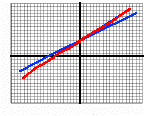 The
plots are different.
The
plots are different.
This is due to the fact that the thin airfoil equation contains an approximation that is only good at small values of a . Foilsim does not use this approximation.
7. The value of lift scales linearly as a function of the area of the wing as can be seen by the linear change in the value of lift.
 |
 |
 |
 |