|
|
 |
|
|
|
|
Step 2.
Using the chart below, record the Airspeed and the Lift. By changing the Airspeed, make at least 9 additional readings. Record these in the chart.
Answers will vary. Samples are shown below:
|
|
|
|
|
|
|
|
|
|
|
|
|
|
|
|
|
|
|
|
|
|
|
|
|
|
|
|
|
|
|
|
|
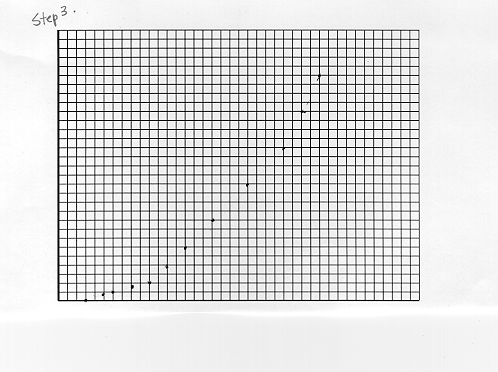
Step 3.
Enter your data into the Lists in your calculator. Set up Stat Plot so that the Airspeed is your independent variable and the Lift is the dependent variable. Graph the data on your calculator and make a sketch in the graph below.
Answers will vary, depending on the answers in Step 2.
Step 4.
In FoilSim in the Plotter Control Panel, select Lift vs. Airspeed. How does this graph compare to yours? The graph should be very similar.
Step 5.
Which kind of function does this graph represent? The graph represents a parabola.
Step 6.
Using the regression equations from your calculator, determine the equation of best fit.
a = .295
b = -.455
c = -8.901
R2 = .999
equation: .295X2 - .455X -
8.901
Step 7.
What does this equation tell you about the relationship between the change in Lift and the change in Airspeed? As the airspeed increases, the lift increases by more than the square of the airspeed.
Step 8.
Using the graph and/or the equation, what would you predict the lift to be given an airspeed of 300 km/hr.?
equation: .295(300)2 - .455
(300) -8.901
Lift = 26,404.59 Newtons
(Note: Have students
check their answers using FoilSim: lift = 26,400 Newtons. Then take
it one step farther and show the regression equation on a
calculator.)
 |
 |
 |
|