|
Answers |
 |
|
|
Answers |
|
In FoilSim click the Play Ball button. Set the Input Panel for Cleveland and the Speed for 85 mph.
Step 1.
Select Ballpark on the Plotter Input panel. What happens to the fastball with 0.00 release point and a 0 release angle? The ball goes straight over the plate.
Step 2.
Repeat Step 1 for the curveball. Will the umpire call this a ball or a strike? Why? The ball curves off to the right of the plate. This is a ball; it is way off the plate.
Step 3.
Looking at the baseball panel from the above steps, determine the "center of the plate." How did you do this?
Measure with a ruler:
Step 4.
Complete the chart below using FoilSim and a small ruler. Select Left hander on the Baseball Input Panel and measure the distance from point A (the center point) to the point where the ball passes the plate. Above the plate should be positive distances, and below the plate should be negative distances. Record the distances for the given release points. Repeat this for a Right hander and record your results.
Answers will vary. Samples are shown below:
|
Release Point (x) |
Curveball - Left hander (y) |
Fastball - Left hander (y) |
Curveball - Right hander (y) |
Fastball - Right hander (y) |
|
|
|
|
|
|
|
|
|
|
|
|
|
|
|
|
|
|
|
|
|
|
|
|
|
|
|
|
|
|
Step 5.
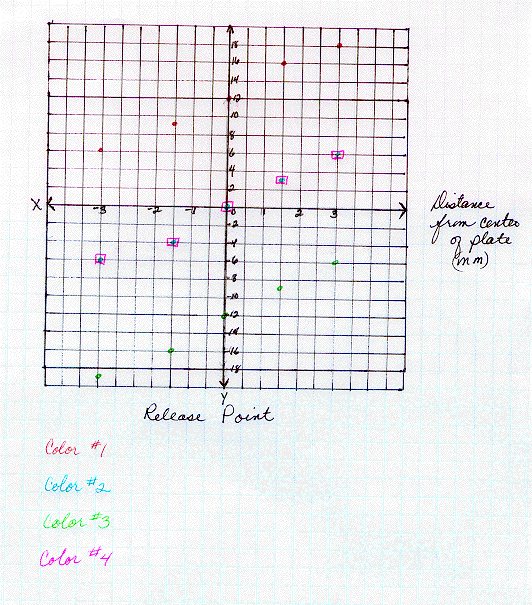
Using four different colored pens graph the information on the graph provided. In each of the graphs the Release Point will be x.
Answers will vary, depending on the answers in Step 4. The samples are shown below:
Conclusions:
b) How do the graphs show you this? They are virtually the same graph.
b) How do the graphs show you this? The graph of the left hander is entirely above the X-axis (the plate) and the graph of the right hander is entirely below the X-axis (the plate). (Note: Above the plate indicates right side, and below the plate indicates left side.)
a) Are you right handed or left handed? Answers will vary.
b) Which pitcher would have the more difficult fastball for you to hit? Why? Both left and right handers should present the same difficulty for a hitter because their resulting positions are the same.
c) Which pitcher would have the more difficult curveball for you to hit? Why? For a right handed batter with a left handed pitcher, the curveball curves away from the batter. For a left handed batter with a right handed pitcher, the curveball curves away from the batter.
 |
 |
 |
|