The Baseball and Air Answers


Step 2.

Using a ruler, measure the distance between the red ball of the probe and the center of the ball. How fast is the airstream moving around the ball at this distance?

Distance 7 mm.
Speed of the airstream 309.2 km/hr

Step 3.

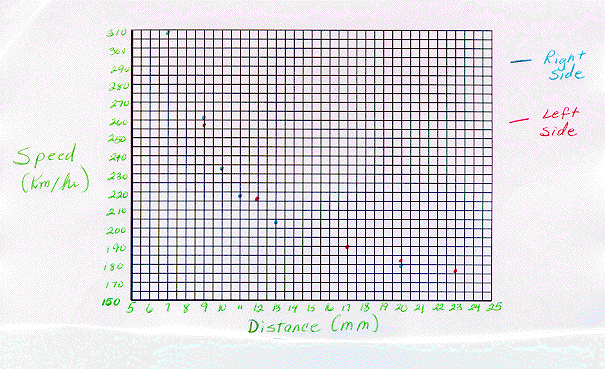
By moving only the left slider in the Probe Control Panel move the probe to the right of the ball and take five readings of distance and speed. Record these in the chart below. Repeat this for five readings to the left of the ball.

Answers will vary. Samples are shown below:

Right Side Distance (X)
Right Side Speed (Y)

Left Side Distance (X)

Left Side Speed (Y)

9 mm
261.0 km/hr
9 mm
257.2 km/hr
10 mm
232.9 km/hr
12 mm
217.0 km/hr
11 mm
218.5 km/hr
17 mm
190.2 km/hr
13 mm
203.6 km/hr
20 mm
182.4 km/hr
20 mm
179.9 km/hr
23 mm
176.0 km/hr

Step 4.

Using two different colored pens, graph the information from the chart on the graph provided. Graph #1 will be the right side of the ball, and graph #2 will be the left side. Answers will vary, depending on the answers in Step 3.
 

Conclusions:

  1. What happens to the airstream as the probe is moved farther from the center of the ball? The airspeed slows as the distance from the center of the ball increases.

  2. Why do you think this happens? The ball displaces air.

  3. What happens if you change the speed of the ball? The airspeed slows but still decreases as the distance from the ball increases.

  4. Does this change what you discovered in Question 1? No.

  5. Does your result change if you throw a curveball? No. a screwball? No.

  6. Examine your graphs. What kind of a relationship exists between an airstream's distance from the ball and the speed of the airstream? An air stream's distance from the ball and the speed of the air stream are an indirect variation. As the distance from the center of the ball increases, the airspeed increases.

  7. Write an equation for one of your graphs. The graph represents a quadratic relationship. Therefore, the equation will be in the form ax2 + bx + c. Several methods can be used to develop the equation. Using a graphing calculator, the regression equation can be easily found. It will be similar to 1.25x2 - 43.48x + 549.36, allowing for differences in recording data.

  8. Why is this the correct equation? It is a quadratic equation that best fits the experimental data.


Please send any comments to:
Web Site Related: Dale Morris (Dale.J.Morris@grc.nasa.gov), Technology Related: Tom Benson(Tom Benson@lerc.nasa.gov)