|
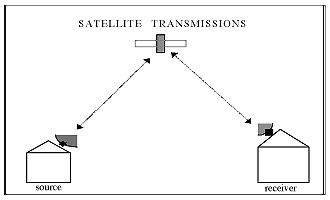
 Signals sent over long distances often use satellites. Satellites can send information to and from places on Earth and from Earth to a space shuttle or other places in space. Satellite antennas transmit and receive signals from a source on the ground or in the air. The signals are bounced off of satellites in space and picked up by an antenna dish at the receiving end. Signals sent over long distances often use satellites. Satellites can send information to and from places on Earth and from Earth to a space shuttle or other places in space. Satellite antennas transmit and receive signals from a source on the ground or in the air. The signals are bounced off of satellites in space and picked up by an antenna dish at the receiving end.
|
There are three types of satellites: 1) Geostationary satellites (GEOs) that remain in orbit about 22,300 miles above Earth, follow the rotation of the Earth, and can cover the same area of the Earth at all times without interruption; 2) Medium earth satellites (MEOs) that travel 5,000-10,000 miles above the Earth so that nine to twelve MEOs are needed for continuous global coverage; and 3) Low earth satellites (LEOs) that travel 500-5,000 miles above the Earth and require a minimum of 48 LEO satellites to circle the Earth for continuous worldwide coverage. GEOs are used for most space communications. LEOs and MEOs are used for Earth-to-Earth communications.
|
In order for ground stations and satellites to send signals to each other, there must be a clear line of sight. There cannot be anything blocking the path between the ground station and the satellite. However, blockage does result when the Earth rotates, carrying the ground station out of view of the satellite during parts of the day. Satellites are, therefore, put into different orbits so that there is continuous coverage as the Earth rotates throughout the day.
|
|
| QUESTIONS - BACK |