|
|
Force
for Takeoff or "Will the airplane get off the ground?"
Subject Area: Mathematics
Grade Level: 9
- 12
National Mathematics
Standards:
- Represent situations
that involve variable quantities with tables, equations, and graphs.
- Make connections and
comparisons between tables, equations, and graphs.
- Draw inferences from
information provided by tables and graphs that summarize data from real-world
situations.
- Use curve-fitting to
predict from data.
- Express mathematical
ideas in writing.
National Technology
Standards:
- Technology research
tools: Use content-specific tools, software and simulations (e.g., environmental
probes, graphing calculators, exploratory environments, Web tools) to support
learning and research; select and use appropriate tools and technology resources
to accomplish a variety of tasks and solve problems.
- Problem-Solving
and Decision-Making Tools - Routinely and efficiently use on-line information
resources to meet needs for collaboration, research, publications, communications,
and productivity.
Objectives:
- Use a graphing calculator
to evaluate data
- Use the World Wide
Web to access data.
- Use data from real-life
models to calculate and compare the force required for an airplane of a
given weight to become airborne.
Most of us have flown
at one time or another. The typical passenger boards an airplane with a piece
of carryon luggage, along with a suitcase in the cargo hold. At takeoff, we
feel the effect of the combination of factors that allow the airplane to complete
a liftoff.
Think about the weight
of the airplane including its internal components (such as the engine, fuel
tanks, landing gear, etc.), the passengers, and all of the luggage or cargo.
This activity will consider the force that is needed to successfully lift
a fully-loaded aircraft off the ground.
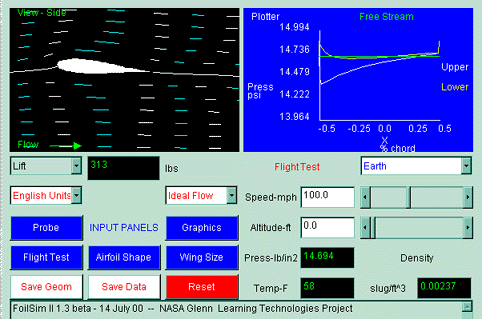
FoilSim is an interactive
simulation software package that examines the airflow around various shapes
of airfoils. As you change parameters such as airspeed, altitude, angle
of attack, thickness and curvature of the airfoil, and size of the wing
area, the software calculates the lift. The package was created at the NASA
Glenn Research Center.
FoilSim II is a Java applet program that executes inside the browser of your computer.
It is available on the World Wide Web at
http://www.grc.nasa.gov/WWW/K-12/airplane/foil2.html.
You can also
download the program to run off-line.
Shown below is a screen
shot from the program's controls and displays. You may change the values
of the variables by using the slider or the input box on the left of the
slider.
To use the slider:
- Click the mouse
pointer on the arrows at the ends of the slider.
- Click the mouse
pointer anywhere between the slider and the arrow.
- Drag the slider
with the mouse.
To use the input
box:
Simply select the
value in the input box, key in the new value, and press Enter or Tab when
finished. The button on the slider will move corresponding to the value
typed in the box.
To begin the activity,
click on the Force for Takeoff Problem.
Assessment:
You, as individuals
or in cooperative groups, will be evaluated on:
- The feasibility of
your answers.
- Your explanations
for given questions.
Evaluation:
- You will be evaluated
on your printout of the plots and graphs created.
- You will be evaluated
on the completeness of the summary of your results in written or typed form.
Submitted by: Christine
Nagy Warren, Olmsted Falls High School, Olmsted Falls, Ohio.
|